


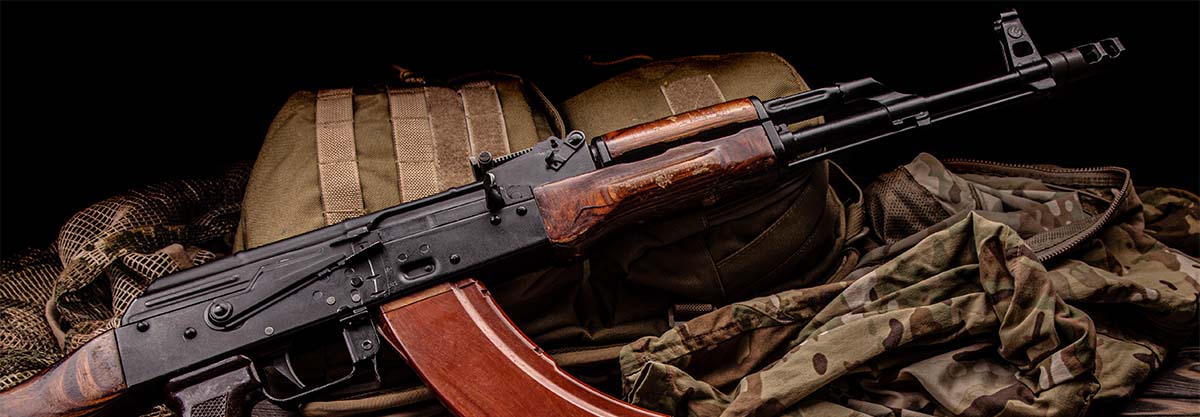
Buy Russian AKM Rifle Online
Russian AKM 7.62mm Automatic Assault Rifle
AKM Assault Rifle

The AKM (Russian: Avtomat Kalashnikova Modernizirovanniy or “Kalashnikov modernized automatic rifle”) is a 7.62mm assault rifle designed by Mikhail Kalashnikov. It is a common modernized variant of the AK-47 rifle developed in the 1940s. Introduced into service with the Soviet Army in 1959, the AKM is the most ubiquitous variant of the entire AK series of firearms and it has found widespread use with most member states of the former Warsaw Pact and its many African andAsian allies as well as being widely exported and produced in many other countries. The production of these Soviet rifles was carried out at both the Tula Arms Plant and Izhmash. It was officially replaced in Soviet frontline service by the AK-74 in the late 1970s, but remains in use worldwide.

AKM Russian 7.62mm Automatic Assault Rifle
The transition from steel to mainly plastic magazines yielded a significant weight reduction and allow a soldier to carry more rounds for the same weight.
AKM Specifications
Caliber |
7,62x39mm |
Magazine capacity |
30 rds |
Muzzle velocity |
715 m/s |
Effective firing range |
350 m |
Length |
870 mm |
Barrel length |
415 mm |
Weight |
3.1 kg |
The AKM (Modernized Kalashnikov Automatic Rifle) is a 7.62mm assault rifle designed by Mikhail Kalashnikov. It is a common modernized variant of the AK-47 rifle developed in the 1940s.

Introduced into service with the Soviet Army in 1959, the AKM is the most ubiquitous variant of the entire AK series of firearms and it has found widespread use with most member states of the former Warsaw Pact and its African and Asian allies as well as being widely exported and produced in many other countries. The production of these rifles was carried out at both the Tula Arms Plant and Izhmash. It was officially replaced in Soviet frontline service by the AK-74 in the late 1970s, but remains in use worldwide.
Compared with the AK-47, the AKM features detail improvements and enhancements that optimized the rifle for mass production; some parts and assemblies were conceived using simplified manufacturing methods. Notably, the AK-47’s milled steel receiver was replaced by a U-shaped steel stamping. As a result of these modifications, the AKM’s weight was reduced by ≈ 1 kg (2.2 lb), the accuracy during automatic fire was increased and several reliability issues were addressed. The AK-47’s chrome-lined barrel was retained, a common feature of Soviet weapons which resists wear and corrosion, particularly under harsh field conditions and near-universal Eastern Bloc use of corrosively primed ammunition.

The AKM’s receiver is stamped from a smooth 1.0 mm (0.04 in) sheet of steel, compared with the AK-47 where the receiver was machined from heavier gauge steel. A rear stock trunnion and forward barrel trunnion are fastened to the U-shaped receiver using rivets. The receiver housing also features a rigid tubular cross-section support that adds structural strength. Guide rails that assist the bolt carrier’s movement which also incorporates the ejector are installed inside the receiver through spot welding. As a weight-saving measure, the stamped receiver cover is of thinner gauge metal than that of the AK-47. In order to maintain strength and durability it employs both longitudinal and latitudinal reinforcing ribs.
The AKM is an assault rifle using the 7.62×39mm Soviet intermediate cartridge. It is gas operated with a rotating bolt. The AKM is capable of selective fire, firing either single shots or automatic at a cyclic rate of 600 rounds/min. Despite being replaced in the late 1970s by the AK-74, the AKM is still in service in some Russian Army reserve and second-line units and several east European countries.The GRAU officially designated the AKM as the 6P1 assault rifle.

Russian AKM 7.62mm for Sale

Izhevsk AKM Rifle
- Built using an Original Russian Izhevsk AKM Parts Kit
- Period correct parts to the original production year of part kit
- Built by the experienced team at Atlantic Arms MFG
- Childers Guns CG1 Receiver with Russian selector marking
- Polish Cold Hammer Forged Barrel, Threaded 14mmx1 LH at the muzzle
- Durable Manganese Phosphate base finish with black Teflon top coat
- Some part numbers from the kit may be force matched
- Original Period Correct Russian Wood Buttstock and Handguards, Surplus Good Condition or Better
- US Black Pistol Grip
- Comes with 1-30 Round U.S. Magazine
- 1 year Warranty
- US 922R compliance parts, US Magazine(3), US Muzzle Brake(1), US Black Polymer Pistol Grip(1) & US Childers Guns CG1 Receiver(1).
-2012-p.png?v=dc908c24-c3ac-448c-8d7a-4c9e03a2a515)
The Russian Izhevsk AKM Rifle is a unique and collectible AKM Rifle built using an original Russian Izhevsk AKM parts kit along with a Childers Guns CG1 receiver that features Russian selector markings. The Original Period Correct Russian Wood Buttstock and Handguards come as the standard furniture. As well as a new US black polymer pistol grip for 922R compliance.These rifles also use a 16″ Polish cold hammer forged and chrome lined barrel with 14x1LH concentric threads at the muzzle. Finally these rifles are finished using a Durable Manganese Phosphate base finish with black Teflon top coat. The rifles ship with one 30 round U.S. made magazine(where legal). These are very limited production. Now is is your chance to own a rare and collectible AKM Rifle built using an original Russian Izhevsk parts kit.
Built using an Original Russian Izhevsk AKM Parts Kit, Dates of manufacturer and other details will vary from pictured. Marking may vary slightly from picture depending on year of original production.Original Period Correct Russian Wood Buttstock and Handguards rated Surplus Good Condition or better, may be dinged, dented, scratched, brunt, chipping. etc. consistent with a 60 year old Military Stock set.

Barrel


The AKM has a barrel with a chrome-lined bore and four right-hand grooves at a 240 mm (1 in 9.45 in) or 31.5 calibers rifling twist rate. The forward barrel trunnion has a non-threaded socket for the barrel and a transverse hole for a pin that secures the barrel in place. The AKM’s barrel is installed in the forward trunnion and pinned (as opposed to the AK-47, which has a one piece receiver with integral trunnions and a barrel that is screwed-in). Additionally the barrel has horizontal guide slots that help align and secure the handguards in place.
To increase the weapon’s accuracy during automatic fire, the AKM was fitted with a slant cut compensator that helps redirect expanding propellant gases upward and to the right during firing, which mitigates the rise of the muzzle during an automatic burst when held by a right-handed firer. The compensator is threaded on to the end of the barrel with a left-hand thread. Not all AKMs have slant compensators; some were also fitted with the older muzzle nut which came from the AK-47. Most AKMs with muzzle nuts were older production models. The AKM’s slant compensator can also be used on the AK-47, which had a simple nut to cover the threads.
Gas block
The gas block in the AKM does not have a cleaning rod capture or sling loop but is instead fitted with an integrated bayonet support collar that has a cleaning rod guide hole. The forward sling loop was relocated to the front handguard retainer cap. The handguard retainer also has notches that determine the position of the handguards on the barrel. The AKM’s laminated wood handguards have lateral grooves that help securely grip the rifle.
Gas relief ports that alleviate gas pressure in the piston cylinder (placed horizontally in a row on the gas cylinder in the AK-47) were moved forward to the gas block and placed in a radial arrangement.

Bolt carrier assembly
The AKM’s bolt carrier has a lightening cut milled into the right side halfway before the handle. The handle has its profile slimmed down too. The stem of the AKM bolt is fluted in another measure to help reduce weight. The round, fluted firing pin of the AK-47 was also replaced with a flat one on the AKM. All pieces are typically painted black instead of left unfinished (“in the white”).
Stock
The buttstock, lower handguard and upper headguard are manufactured from birch plywood laminates like the later model AK-47 furniture. Such engineered woods are stronger and resist warping better than the conventional one-piece patterns, do not require lengthy maturing, and are cheaper. The wooden buttstock used in the AKM is further hollowed in order to reduce weight and is longer and straighter than that of the AK-47, which assists accuracy for subsequent shots during rapid and automatic fire. The wooden stock also houses the issued cleaning kit, which is a small diameter metal tube with a twist lock cap.

The kit normally contains the cleaning jag to which a piece of cloth material is wrapped around and dipped into cleaning solution. It also contains a pin punch, an assembly pin to hold the trigger, disconnector and rate reducer together while putting these back into the receiver after cleaning the weapon, and a barrel brush. The kit is secured inside the butt stock via a spring-loaded trapdoor in the stock’s pressed sheet metal butt cap. The stock is socketed into a stepped shaped rear trunnion with single upper tang and two screws. The rear trunnion itself is held to the stamped receiver with four rivets (two on each side). Under folding models instead have a U-shaped rear trunnion that reinforces the locking arms and is held to the receiver with six rivets

Recoil/return spring assembly
The AKM uses a modified recoil/return spring mechanism, which replaces the telescoping recoil spring guide rod with a dual U-shaped wire guide.
Trigger assembly
The AKM has a modified trigger assembly, equipped with a hammer-release delaying device (installed on the same axis pin together with the trigger and disconnector) commonly called a “rate reducer” or “hammer retarder” (Russian: замедлитель срабатывания курка). In fact its primary purpose is not to reduce the rate of automatic fire; it is a safety device to ensure the weapon will only fire on automatic when the bolt is fully locked, as the hammer is tripped by the bolt carrier’s last few millimetres of forward movement.
The device also reduces “trigger slap” or “trigger bounce” and the weapon’s rate of fire, which also reduces the dispersion of bullets when firing in fully automatic mode. The hammer was also changed and equipped with a protrusion that engages the rate reducer and the trigger has only one notched hammer release arm (compared with two parallel arms in the AK-47).
Sights
The AKM’s notched rear tangent iron sight is calibrated in 100 m (109 yd) increments from 100 to 1,000 m (109 to 1,094 yd) and compared with the AK-47 the leaf’s position teeth that secure the sliding adjustable notch were transferred over from the right to the left edge of the ramp. The front sight is a post adjustable for elevation in the field and has a slightly different shape with the “ears” being angled with the back of the base instead of strait and its bottom portion is more narrow compared with the AK-47. Horizontal adjustment requires a special drift tool and is done by the armoury before issue or if the need arises by an armourer after issue.
The sight line elements are approximately 48.5 mm (1.9 in) over the bore axis. The “point-blank range” battle zero setting “П” on the 7.62×39mm AKM rear tangent sight element corresponds to a 300 m (328 yd) zero. For the AKM combined with service cartridges the 300 m battle zero setting limits the apparent “bullet rise” within approximately −5 to +31 cm (−2.0 to 12.2 in) relative to the line of sight. Soldiers are instructed to fire at any target within this range by simply placing the sights on the center of mass (the belt buckle, according to Russian and former Soviet doctrine) of the enemy target. Any errors in range estimation are tactically irrelevant, as a well-aimed shot will hit the torso of the enemy soldier.
Magazines
The early slab-sided steel AK-47 30-round detachable box magazines had 1 mm (0.039 in) sheet-metal bodies and weigh 0.43 kg (0.95 lb) empty. The later steel AKM 30-round magazines had lighter sheet-metal bodies with prominent reinforcing ribs weighing 0.33 kg (0.73 lb) empty. To further reduce weight a light weight magazine with an aluminium body with a prominent reinforcing waffle rib pattern weighing 0.19 kg (0.42 lb) empty was developed for the AKM that proved to be too fragile and the small issued amount of these magazines were quickly withdrawn from service. As a replacement steel-reinforced 30-round plastic 7.62×39mm box magazines were introduced.
These magazines discolour over time from yellowish to rust-coloured shades, weigh 0.24 kg (0.53 lb) empty and are often mistakenly identified as being made of Bakelite (a phenolic resin), but were actually fabricated from two-parts of AG-4S moulding compound (a glass-reinforced phenol-formaldehyde binder impregnated composite), assembled using an epoxy resin adhesive. Noted for their durability, these magazines did, however, compromise the rifle’s camouflage and lacked the small horizontal reinforcing ribs running down both sides of the magazine body near the front that were added on all later plastic magazine generations.
A second generation steel-reinforced dark-brown (colour shades vary from maroon to plum to near black) 30-round 7.62×39mm magazine was introduced in the early 1980s, fabricated from ABS plastic. The third generation steel-reinforced 30-round 7.62×39mm magazine is similar to the second generation, but is darker coloured and has a matte non-reflective surface finish. The current issue steel-reinforced matte true black non-reflective surface finished 7.62×39mm 30-round magazines, fabricated from ABS plastic weigh 0.25 kg (0.55 lb) empty. Early steel AK-47 magazines are 9.75 in (248 mm) long, and the later ribbed steel AKM and newer plastic 7.62×39mm magazines are about 1 in (25 mm) shorter.
The transition from steel to mainly plastic magazines yielded a significant weight reduction and allow a soldier to carry more rounds for the same weight.
| Rifle | Cartridge | Cartridge weight | Weight of empty magazine | Weight of loaded magazine | Max. 10.12 kg (22.3 lb) ammunition load* |
|---|---|---|---|---|---|
| AK-47 (1949) | 7.62×39mm | 16.3 g (252 gr) | slab-sided steel 430 g (0.95 lb) |
30-rounds 916 g (2.019 lb) |
11 magazines for 330 rounds 10.08 kg (22.2 lb) |
| AKM (1959) | 7.62×39mm | 16.3 g (252 gr) | ribbed stamped-steel 330 g (0.73 lb) |
30-rounds 819 g (1.806 lb) |
12 magazines for 360 rounds 9.83 kg (21.7 lb) |
| AK-103 (1994) | 7.62×39mm | 16.3 g (252 gr) | steel-reinforced plastic 250 g (0.55 lb) |
30-rounds 739 g (1.629 lb) |
13 magazines for 390 rounds 9.61 kg (21.2 lb) |
Accessories

.JPG)
The AKM comes supplied with a different accessory kit that contains a M1959 6H4 or 6H3-type bayonet and comes with synthetic or steel magazines. Both the 6H3 and 6H4 bayonet blade forms a wire-cutting device when coupled with its scabbard.
The polymer grip and upper part of the scabbard provide insulation from the metal blade and bottom part of the metal scabbard, using a rubber insulator sleeve, to safely cut electrified wire. The kit also comes with a punch used to drive out various pins and a device that aids in assembling the rate reducing mechanism. The GP-25 Grenade launcher can also be fitted onto the AKM. There is also the PBS-1 silencer from the 1960s, designed to reduce the noise when firing, mostly used by Spetsnaz forces and the KGB.
Ammunition
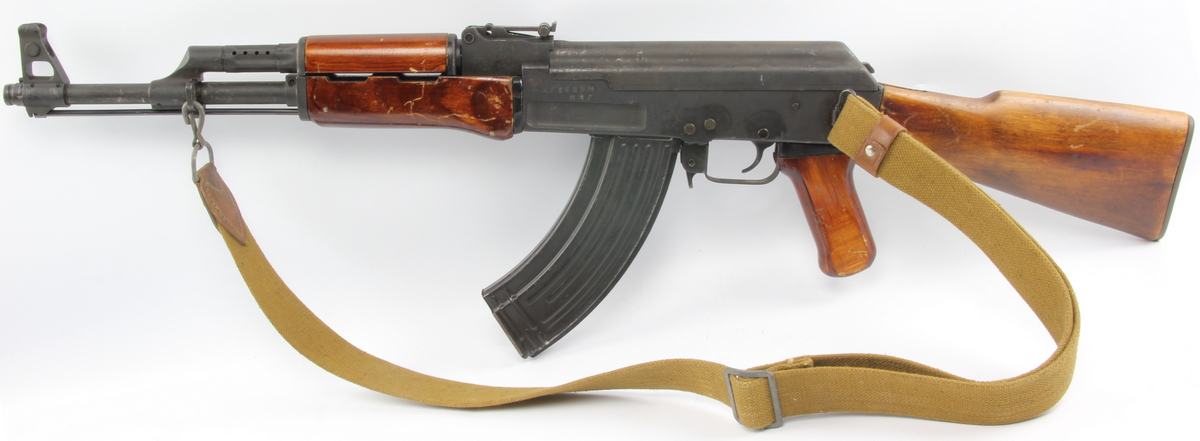
The weapon uses the same ammunition as the AK-47: the 7.62×39mm M43 intermediate rifle cartridge. The AKM mechanism’s design principles and procedures for loading and firing are practically identical to those of the AK-47, the only difference being the trigger assembly (during the return stage of the bolt carrier on fully automatic mode) as a result of incorporating the rate reducer device.


Reviews
There are no reviews yet.